

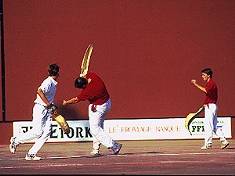
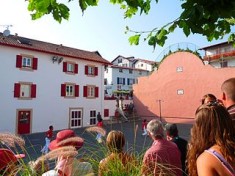
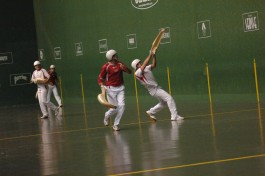
© photos J.P Plantey. OT Bidart. OT St Jean de Luz
The following information was kindly donated by the FFPB (Federation Francaise de Pelote Basque)
Trinquet Moderne. B.P. 816. 64108 Bayonne Cedex Tel: 05 59 59 22 34
THE "PELOTE" (the name for the Ball), is made with a wound rubber center
(like a golf ball construction) bound with cotton, plus two fine leather skins all sewn together.
Each Pelote or ball is hand made and must form a perfect sphere on completion.
The diameter is 65 mm and the total weight is from 115grms - 125grms and as hard as a
stone, with measured speeds of 250 to 300 km /h when utilizing the Chistera, which makes
this the fastest bat and ball sport in the world.
THE "MAIN NUE"
The "Main Nue"(bare hand) is the ancestor of all the basque sports, the players use only the palms of their hands to hit the Pelote.
THE "CHISTERA"

The "Chistera" is the name used for the long curved basket (starting with a
leather glove) which is made of different woods and reeds (hard & soft) for the games "Chistera" & "Cesta Punta".
The Chistera can't be fabricated industrially, as tests were made with a plastic Chistera and it doesn't resist the
temperature changes it has to go through during a game.
It is a very long handcrafted process to make one of these and they are only made to order.
LE "REBOT"

The "Rebot" is the name used for the slightly shorter curved basket (starting with a leather glove) which is made of different woods and reeds (hard & soft) for the games "Rebot" & "Joko Garbi".
The "PALA"


The "Pala" is the name for a heavy wooden bat, which is used to play several different types of games,
Pala, Pala Corta, Paleta, Paleta Gomme which are all different, according to the size of wooden bats (close to 1 kilo each).
They are played with a pelote of 100grms.
THE "FRONTON" is the name for a marked out court on the
floor surfaces (some what like a Tennis court), which varies with the markings for the
different types of game of Pelote Basque.
Every self-respecting village in the Pays Basque and Southern Landes has its outdoor "Fronton"
known as "Fronton Place Libre", which consist of a rectangular court marked with
service and fault lines plus a large pink shaped wall at one end, marked with 2 vertical
lines which define the playing area, the 2 sides and end are left open.
The length of the Fronton Place Libre in each village defines what type of Pelote can be
played on it, this seems to vary from 30m to 120m (the towns with 80m plus, generally have
a wall at each end so that 2 games of Pala can be played at once or 1 game of Chistera).
THE "JAÏ ALAÏ" is an in-door fronton covering a "cancha" (56 meters
long) which is used exclusively to play Cesta Punta. The game utilizes three walls: the
front (11.5m wide x 10.5m high), the back (10.5m wide x 9.0m high) and the left hand wall
(marked at 10.5m high x length) which is divided in 14 "cuadros" (numbered from
one - fourteen, 4.0m apart), on the right side of the court 3.5m over is a full height net
to guard the stands and public galleries from this high speed game.
Two teams of two play
the game to 35 points. The service is made with a chistera from the number 11 cuadros (44
meters) and the ball (called a pelote) must bounce between the number 4 and the number 7
on the way back.
If the pelote falls before the 4th cuadros (called "falta"),
they loose the point and the other side commence to serve, and if it falls after the 7th
cuadros (called "pasa") it is a half fault and they have a second chance at the
service.
THE "FRONTON AVEC MUR A GAUCHE" (with left hand wall) is an in-door fronton covering a "cancha" (36 meters long) where Pala or Main Nue are played. The game utilizes three walls: the front (10.5m wide x 9.25m high), the back (9.5m wide x 8.0m high) and the left (marked at 9.25m high x length) which is divided in 10 "cuadros" (numbered from one - ten, 3.5m apart), on the right side of the court 2.5m over is a full height net to guard the public galleries from the players, (bats) and pelote.
THE "TRINQUET" is an in-door fronton covering a "cancha" (28.5 meters
long). The games utilize three walls: the front (9.30m wide x 8.50m high), the back (9.30m
wide x 5.50m high) and the left (marked at 5.50m high x length) which is divided into 6
"cuadros" (numbered from one - six, 2.5m apart), starting 7.25m from the front
wall, this court incorporates a right hand wall.
The Trinquet has other added nightmares in the court area, an observation gallery (for
lack of the real name) for the public or adjudicators to view, which has been constructed
down the left hand wall and along the rear wall, 1.3m deep x 2.25m high with a sloped
roof and netted windows.
The gallery is included as part of the game, as the objective
is to bounce the ball off several walls and the roof of the gallery to confuse the
opponent as to where the ball might land.
The right hand corner front wall is set at an
angle of 45° x nearly ½ a meter wide, plus adjacent to this is a 60cm (2ft) square hole
called a "Xilo", with angled edges and its center at 1.5m off the floor. If the
player can hit the Xilo or the corner with the ball it can go anywhere, which creates a
problem for their opponent.
| Name of Game | Type of Fronton | N°. of Players in each Team |
|---|---|---|
| CHISTERA | Fronton Place Libre | 3 |
| CESTA PUNTA | Fronton Jai Alai | 1 or 2 |
| JOKO GARBI | Fronton Place Libre | 2 or 3 |
| REBOT | Fronton Place Libre | 5 |
| PALA | Fronton Place Libre | 2 |
| PALA CORTA | Fronton Mur a Gauche | 2 |
| PALETA | Fronton Mur a Gauche Fronton Trinquet | 2 |
| PALETA GOMME | Fronton Place Libre | 2 |
| MAIN NUE | Fronton Place Libre Fronton Mur a Gauche Fronton Trinquet | 1 or 2 |
| Arcangues | Bayonne | Biarritz | Bidart |
| Ciboure | Hendaye | Guethary | Saint Jean-de-Luz |
| Capbreton | Dax | Hossegor | Labenne |
| Moliets | Ondres | Seignosse | Soustons |
| Tarnos | Vieux Boucau |
